Professional coffee machine for Malaysian offices: a plain buying guide
If you have searched for a professional coffee machine for your office, you have probably already ruled out the home machine sitting on your kitchen counter. You need something that can handle a real daily workload, produces a consistent cup without a dedicated barista standing next to it, and does not turn into a maintenance project for your facilities team. That is the gap this guide is written for.
We will walk through the main machine types, help you figure out what capacity you actually need, and be honest about the tradeoffs between buying, renting, and using a fully managed service. If Otter Barista sounds like the right fit by the end, great. If something else serves you better, this guide will still have been worth your time.
What 'professional coffee machine' actually means in an office context
The term covers a wide range, from compact bean-to-cup units that sit on a pantry counter to large traditional espresso setups that need a trained operator. For most Malaysian offices, the practical definition is this: a machine that grinds real beans, pulls real shots, and does it consistently across dozens of cups a day without someone babysitting it.
It is not a home machine (those are not built for daily commercial volume). It is also not a full café setup (those need a barista, a grinder, a workflow, and someone accountable for quality every hour of the day). A professional office coffee machine sits in the middle: reliable output, low operator dependency, and enough capacity to keep a team caffeinated through a busy morning.
The main machine types and what they are actually like to run
Bean-to-cup super-automatic. These machines grind, dose, tamp, and brew in one automated sequence. Push a button, get a latte. The consistency is high because the human variable is mostly removed. Cleaning cycles are built in. For offices without a dedicated barista, this is usually the most practical format.
Traditional espresso machine. The kind you see behind a café counter. Capable of excellent coffee, but only in the hands of someone who knows how to use it. Dosing, tamping, extraction time, steam wand technique: all of these require skill and daily attention. If your office does not have that person, the quality will drift fast.
Pod or capsule machine. Low friction to set up and use. The downside is that you are locked into proprietary pods, the cost per cup adds up quickly at scale, and the output rarely matches freshly ground beans. Fine for a small team with low volume; less suited to a busy office pantry.
Filter or drip machine. Makes a large batch at once, which is practical for high-volume situations where people want basic black coffee. The tradeoff is that a pot sitting on a hotplate for an hour tastes nothing like a fresh shot. Good as a supplement, not as your main coffee offering if quality matters.
For most Malaysian offices that want café-quality coffee without a dedicated barista, the bean-to-cup super-automatic format is where the conversation usually lands. You can read more about how this compares in practice in our guide to automatic coffee machines for offices.
How many cups per day do you actually need
This is a question most buyers skip, and it causes problems later. Headcount alone is not the right number to plan around. Think about peak demand: how many people are likely to want coffee at the same time, across what hours, and what happens to demand outside of 9 to 5?
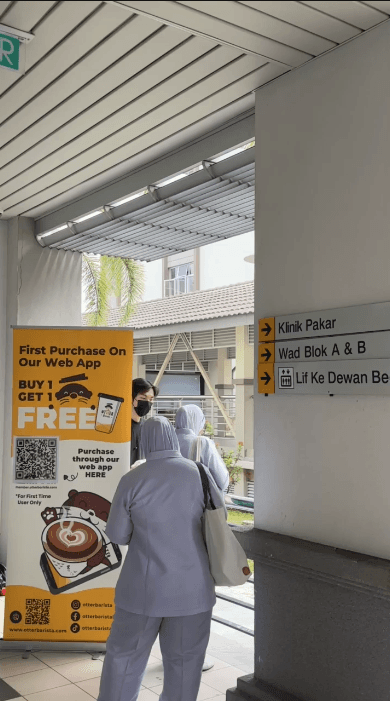
A team of 30 office workers with a predictable morning rush is a manageable load for most professional machines. But consider a hospital ward. A nurse on a 12-hour shift does not drink coffee at 9am and then clock out. She needs reliable access at 2am, at the handover point, and during whatever quiet moment she can grab. A security guard on an overnight rotation has the same need. These are not edge cases. They are the reason that capacity planning has to account for shift patterns and operational hours, not just a standard working day.
If your workplace runs across shifts, or if access to the machine is 24 hours, you need a setup that is built for it. Not all machines and not all service models are.
Buy vs. rent vs. managed service: the real tradeoff
This is where most buying decisions go wrong, and it is worth being direct about it.
Buying outright means you own the asset. That sounds good until the machine breaks down at 8am on a Monday. Now the repair bill is yours, the parts lead time is yours, and the downtime is your team's problem. For a machine running daily at commercial volume, servicing is not optional. It is a recurring cost you need to plan for regardless of whether you have budgeted for it.
Renting shifts the capital cost into a monthly operating expense. This is easier to budget and easier to justify internally. But a bare rental agreement is not the same as a managed service. Read the fine print: is maintenance included? Who covers parts? What is the response time when something fails?
A managed service is the model where someone else handles everything: installation, restocking, servicing, and repairs. You pay a predictable amount and someone else carries the operational risk. This is a higher monthly cost than a bare rental in most cases, but the comparison should be against the total cost of ownership for a machine you buy, including servicing contracts, consumable management, and the staff time spent dealing with it.
For a full breakdown of what rental and managed options look like in Malaysia, the coffee machine rental Malaysia guide goes into the details. And if you are weighing up whether the investment is worth it at all, are office coffee machines worth it answers that question directly.
What a managed robotic barista model looks like in practice
This is where Otter Barista comes in, about halfway through this guide, because that is the right place for it. The buying context above is the same whether you work with us or anyone else.
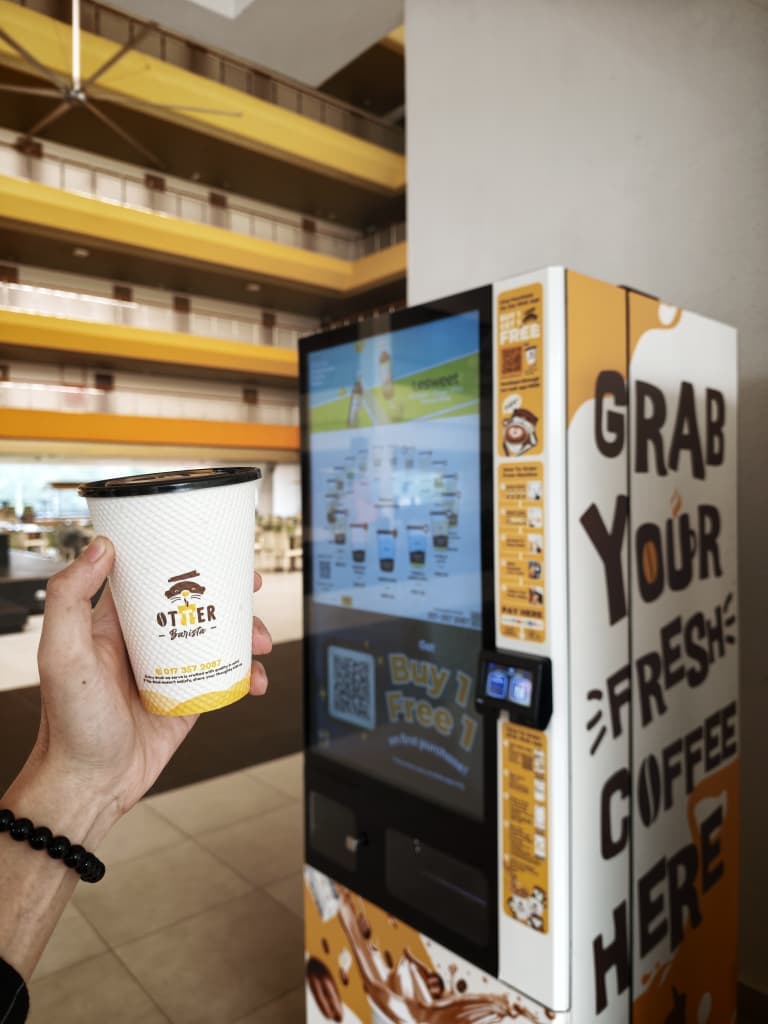
Our machines are bean-to-cup robotic baristas. Every cup starts with freshly ground beans, a blend of Brazilian and Indian Arabica roasted locally in Malaysia. The milk is dairy powder sourced from New Zealand. That is a deliberate choice: powder holds quality better than fresh milk sitting in a machine for days. We tested both and the powder won. We are upfront about it because we think you should know what is in your cup.
The drink menu covers espresso, americano, latte, café latte, flavoured lattes (vanilla, hazelnut, salted caramel, matcha, and our signature Ottersaur latte), caramel macchiato, mocha, dirty matcha, hot chocolate, and a babyccino. Hot or cold, with adjustable sugar levels.
What keeps the quality consistent is not the machine. It is the team behind it. We service every machine every week. When a sensor fails, someone on our team gets the replacement part to the machine fast, even if it is in Ipoh. When someone sends a late-night message saying their coffee tastes off, a real person responds. That is the work that most people do not see, and it is the reason the cup tastes the same on a Tuesday as it does on a Friday.
Under our Host model, we place the machine at your location at no installation cost to you. We handle stocking, servicing, and operations. You receive a fixed monthly rental. There is no revenue share, no hidden variable. It is a straightforward arrangement.
For offices that want to provide coffee directly to their team and cover the cost themselves, our Pantry model is the right fit. Same machine, same service standard, different commercial arrangement.
What to ask any supplier before you sign
These questions apply whether you are talking to us or anyone else. A supplier who cannot answer them clearly is one to be cautious about.
How often is the machine serviced, and who does it? Routine servicing should happen on a fixed schedule, not only when something breaks.
What happens when a part fails? Ask specifically about lead times for replacement parts and whether the machine is swapped out or left down while you wait.
Who handles restocking? Consumables (beans, milk, cups) need to be managed consistently. Clarify whether that is your responsibility or the supplier's.
Are there costs outside the monthly fee? Callout charges, parts markups, and cup costs can turn a headline rental rate into something much higher.
What is the process for urgent issues? If the machine is down at 7am and 60 people need coffee before a 9am meeting, what happens? Get a real answer, not a generic SLA.
For more on what good office coffee service looks like end to end, the office coffee service guide covers this in more depth.
Where Otter Barista operates and how to get started
We currently operate across Klang Valley, Penang, Perak, and Pahang. If your office or building is in one of these regions, we can talk through the right model for your situation.
No hard sell here. If you want to know what a machine would look like at your location, and what the arrangement would involve, reach out and we will give you a straight answer.
- WhatsApp: +60 17 357 2087
- Email: hello@otterbarista.com
Or if you are ready to talk specifics, go to /place-a-machine and we will take it from there.