How much does an office coffee machine cost malaysia: what the price question is really asking
If you have ever searched for how much an office coffee machine costs in Malaysia, you already know the frustrating part: no one gives you a straight number. That is not because providers are hiding something. It is because the question, as most buyers frame it, does not have a single answer. The cost depends on the machine type, who owns it, who services it, what consumables are included, and which model you choose. This article helps you cut through that and figure out what you are actually paying for, so you can bring a sensible proposal to your next budget conversation.
The question behind the question: what office buyers really need to know about cost in Malaysia
Most people searching this phrase are not looking for a price list. They have been asked to sort out the coffee situation at their office and they need to come back with something concrete. The real question is usually: which approach makes sense for us, and how do I get it approved?
The answer starts with understanding that the model matters more than the machine. Two offices can end up with very similar cups of coffee and very different cost structures depending on how they set things up. Getting clear on the model first makes the rest of the conversation much easier.
The three ways to get an office coffee machine and what each costs you in Malaysia
Broadly speaking, there are three approaches to bringing coffee into a workplace.
Outright purchase. You buy the machine. You own it. You are also responsible for repairs, descaling, sourcing beans, and calling a technician when something goes wrong. For businesses that want full control and plan to keep a machine for many years, this can make sense. But the upfront cost is significant and the ongoing maintenance burden is easy to underestimate.
Rental or managed service. A provider places a machine at your location, keeps it stocked, and services it on a regular basis. You pay a recurring fee. This model is popular with offices because it removes the maintenance headache and turns a large capital spend into a predictable operating cost.
Pay-per-use or pantry arrangement. The machine is placed and managed by the provider, but the cost model is tied to consumption. In some cases the location earns a return from machine revenue. In others, the organisation pays for the coffee their team drinks.
Otter Barista offers two models that sit in the second and third categories: the Host model and the Pantry model. More on those below.
What is actually included (and what is not)
This is where most buyers get caught out. A monthly quote is almost meaningless without knowing what sits behind it. When you are evaluating any provider, ask what the number actually covers.
The components of the true cost of a workplace coffee setup are:
- The machine itself (purchase, rental, or placement at no cost depending on the model)
- Coffee beans and other consumables (milk powder, cups, cleaning materials)
- Routine servicing, including cleaning cycles and parts replacement
- Breakdown response, meaning how quickly someone shows up or sends a part when something fails
- Payment and ordering infrastructure, if the machine needs to accept cashless payment or support a loyalty programme
Two quotes with the same monthly figure can be worlds apart once you look at this list. One provider might include all consumables and on-site servicing. Another might charge separately for each callout.
At Otter Barista, the service model is built around the belief that the technology is the easy part. The hard part, and the reason the coffee stays consistent, is the team servicing every machine every week. We do not install and disappear. When a sensor fails in a machine in another city, we get the part there fast. When someone messages at an odd hour saying the coffee tastes off, someone on our team responds. That kind of ongoing attention is what keeps a workplace coffee setup actually working, and it is worth asking any provider how they handle it.
Capex vs. opex: how the framing changes your internal approval
For many office managers and HR teams, the biggest obstacle to getting a coffee machine approved is not the cost itself. It is the budget category.
A large upfront machine purchase is a capital expenditure. It typically needs a different approval process, sometimes involving procurement committees or finance sign-off at a higher level. A monthly managed service, on the other hand, sits in operating expenditure. It is a recurring line in the budget, similar to a cleaning contract or a software subscription.
For most offices, the opex framing is significantly easier to get through internal approval. A fixed monthly amount with no surprise repair bills is a much simpler conversation than a five-figure purchase with ongoing maintenance costs that are hard to predict.
If you are building a business case internally, framing the managed service model this way tends to land better with finance teams.
How office size and usage shape the right choice
There is no minimum team size that justifies a coffee machine. The better question is: how often will people actually use it, and where will the machine live?
A small team in a quiet office with occasional visitors has different needs than a hospital ward running around the clock, a university corridor with students cycling through between classes, or a large corporate floor with hundreds of staff. The machine should be where people already are, serving the kind of volume that matches that location.
Otter Barista operates across Klang Valley, Penang, Perak, and Pahang, and the locations we work with range from compact offices to large public buildings. Our belief is simple: good coffee should not depend on where you work. A nurse on a 12-hour shift deserves the same café latte as someone working in a comfortable city-centre office. The right setup is the one that fits the actual usage pattern of your space, not the one that looks impressive in a brochure.
If you are unsure which model fits your situation, the office coffee page gives a starting point, and we are always happy to talk through the specifics.
Questions to ask any provider before you commit
Before you sign anything, run through this checklist. It applies to us as much as to anyone else.
- What happens if the machine breaks down? Who pays for the repair and how quickly does someone respond?
- Is routine servicing included in the monthly fee, or billed separately?
- Are consumables (beans, milk, cups) included or do you invoice for those on top?
- What is the minimum contract term and what are the exit conditions?
- Is the machine Halal-compliant? This matters for corporate and public-sector buyers in Malaysia and you deserve a straight answer, not a vague assurance.
- Does the machine support cashless payment?
- Who do you call when something goes wrong at 7am before the office opens?
A provider who answers these questions clearly and without hesitation is one worth trusting. One who deflects or adds caveats to every answer is telling you something.
How Otter Barista's models work
We run two models that are relevant to most office and workplace buyers.
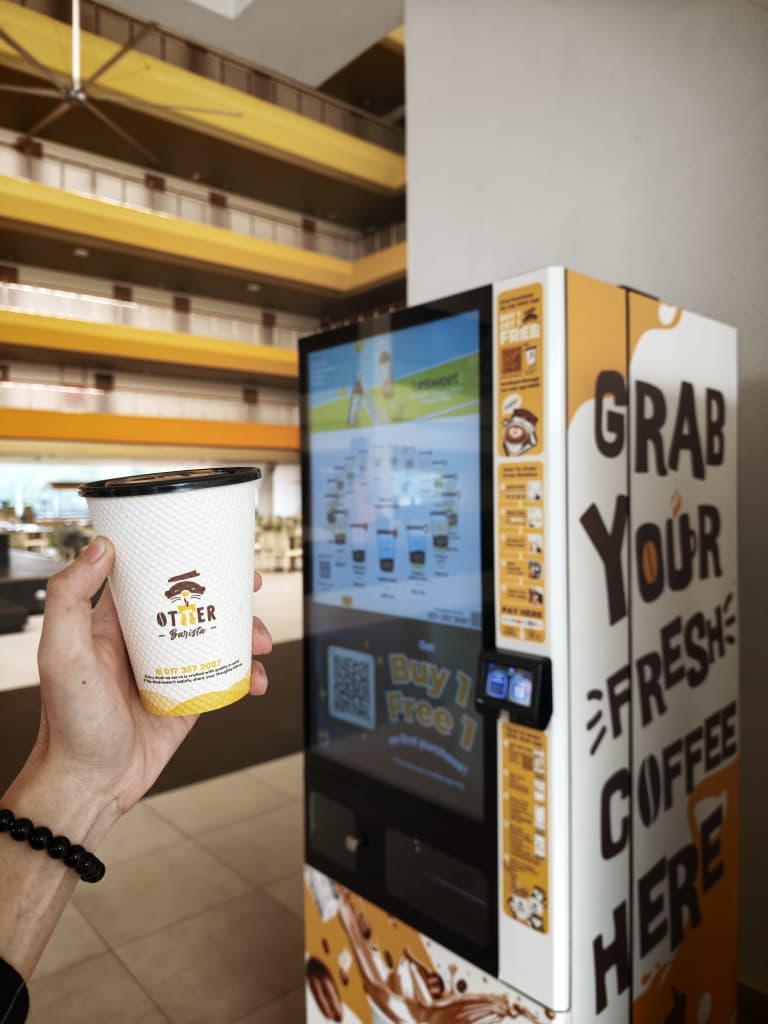
The Host model is designed for locations that have foot traffic: offices, clinics, condos, campuses, and similar spaces. We place a Robotic Barista at your location at no cost to you. We deploy it, stock it with fresh-ground Arabica beans and New Zealand dairy powder, and service it ourselves on a regular schedule. You receive a fixed monthly rental from us. You are not managing the machine, sourcing the coffee, or calling technicians. We do all of that. The machine is accessible to anyone at your location, not just your team.
The Pantry model is for organisations that want the coffee experience for their own people. Your business covers the cost of the coffee, and we keep the machine stocked and running. This works well for companies that want a staff benefit rather than a public-facing machine.
Neither model involves publishing a specific price here, because the right number depends on your location, usage, and setup. What we can do is talk through your situation and give you a real quote. You can also explore more about how the Host model works on the place a machine page, or read about coffee machine rental options if you want to understand the broader picture before reaching out.
For teams with specific contexts, such as healthcare settings, the coffee machine for hospitals page and coffee machine for offices in KL page have relevant detail.
The honest next step
If you came here looking for a price and you are leaving without one, that is intentional and we hope it was still useful. The right cost for an office coffee setup in Malaysia depends on factors that no article can answer for your specific situation: your location, your team size, your usage pattern, and how your organisation handles budget approvals.
What we can do is have a genuine conversation about it. No hard sell, no pressure. Just a straightforward chat about what would actually work for your space.
Reach us on WhatsApp at +60 17 357 2087 or email hello@otterbarista.com. Or if you are ready to explore placing a machine, head to the place a machine page and we will take it from there.